Leadership
Only As Good As Your Team
In my last article, I wrote about how designers burn out when they aren't heard or invited to decision-making. Something stuck with me after I published it. Any product design team is only as good as the people around them.
Companies call this group different things. The Core team. Trio. Three-in-a-box. I'm going to call it the triad: product manager, design lead, and engineering lead working together on a product area.
If each side of this pyramid doesn't pull its weight equally, the entire team suffers. That suffering spreads. It affects trust in leadership. It affects promotions, pay, bonuses, and respect within each department. It also results in the blame being placed on one of the three roles when the real problem lies in the structure itself.
This goes beyond being aligned in meetings or enjoying working together. The triad has to tackle problems together, own outcomes together, and back up their work with data and results. Vague results don't count. Revenue increases, shortened time-to-market, and improved brand perception are what count.

Outcome Over Output
The numbers are hard to argue with. Aligned organizations are nearly twice as likely to hit financial targets. Design-led companies see 32% faster revenue growth. Misaligned teams lose 10-15% of potential revenue and take 45% longer to launch products.
When leadership works together and empowers cross-functional teams to make decisions, revenue growth is 35% higher, and profit margins are 10% higher. High performers complete medium-sized product changes in 2-4 months. Lagging teams can take up to a year for the same results.
Organizations that adopt outcome-focused triads achieve 30-45% faster time-to-market and are 25-40% more likely to meet product success metrics than siloed teams.
Getting your product into users' hands faster means you start seeing results sooner. It gives teams time to make adjustments that increase satisfaction. If the triad works from a feature release roadmap instead of an outcome-based one, they're already set up to fail.
AI Changes the Dynamic
AI blurs roles now more than ever. PMs can build prototypes. Designers can ship code. This has led some leadership teams to believe a "product generalist" could replace all three roles.
Merging roles may be cheaper and faster, but it usually degrades product quality. The triad doesn't exist because no one person can do the other's job. It exists because spreading accountability creates strength through tension.
58% of teams now use AI research tools. Yet generative models hallucinate, miscategorize, and produce plausible nonsense. If you don't build evidence gates that let a human review machine-generated insights, you'll ship a product that kills trust much faster than shipping late would.
When you try to make a one-person band, you don't get the same attention for each instrument.

Research Becomes Everyone's Job
70% of UX designers, 42% of product managers, and 18% of marketers now actively gather their own user insights. Research has become a cross-functional responsibility, whether teams planned for it or not.
This happened because UX research teams can only support about half of the requests they receive. Designers started doing their own research out of necessity.
The triad has to adapt, and non-specialists need training to avoid contaminating data. UX researchers are most valuable when they review how others conduct research, review questions and analyses, and lead larger initiatives that inform new product directions. Let the triad focus on existing customers and product needs. Let research specialists handle the bigger picture.
55% of companies report needing more and better user research even as budgets tighten. They aren't looking to hire more people, so they need their existing teams to figure it out.
The Leadership Problem
Different departments lead tech companies of all shapes and sizes, all jockeying for position. This is often a C-level issue that cascades down, causing confusion and frustration. Teams don't know who to listen to and usually default to their individual department head.
When the message at the top differs per team, blaming the triad for not hitting results is hypocritical at best and destructive at worst.
Proving ROI
It's easier for teams to show what isn't working than to have people trust them about what did work. This is the constant battle that happens in many orgs.
Design-centered companies can see up to 32% faster revenue gains. Poor design has driven 88% of users away from products, while properly designed products (UI and experiences) can boost conversion rates by as much as 400%.
These aren't small numbers. They can change a business entirely.
An aligned triad is more likely to hit financial targets and outperform the competition. It starts with that small team working together, having each other's backs, and providing not just results but the actions that stem from them.

Rules for a Successful Triad
Every organization works differently. Different leadership, different regulations, different complexity. But the teams I've led and been part of have all followed these rules:
1. Define joint OKRs tied to business outcomes, not task completion — Reduce customer churn by 3%. Increase conversion rate by 2%. Shared metrics mean shared accountability.
2. Give each member veto rights — Any member can challenge decisions that compromise desirability, viability, or feasibility. Healthy tension prevents groupthink.
3. Make research everyone's job — Build basic training and templates so non-researchers can run simple studies. Free up research specialists for the complex work.
4. Require evidence before major decisions — The triad jointly reviews insights and decides whether to proceed. This prevents AI-generated ideas from bypassing human judgment.
5. Run discovery and delivery at the same time — Dual-track agile. All three roles participate in user research sessions and iterate based on live data.
6. Develop T-shaped skills — PMs learn technical constraints. Engineers join user interviews. Designers learn analytics. Fewer handoffs. More empathy.
7. Treat data as the fourth team member — Make analytics accessible to everyone. When data is treated as a product, decision-making improves.
8. Get leadership to protect discovery time — Executives must invest in research ops and guard against scope creep. Without top-down support, triads revert to firefighting.
9. Tie incentives to team outcomes — Bonuses and promotions based on team results, not individual output.
10. Make dissent safe — Open channels where concerns are welcomed. Distributing responsibility leads to better decisions and less burnout.
The Point
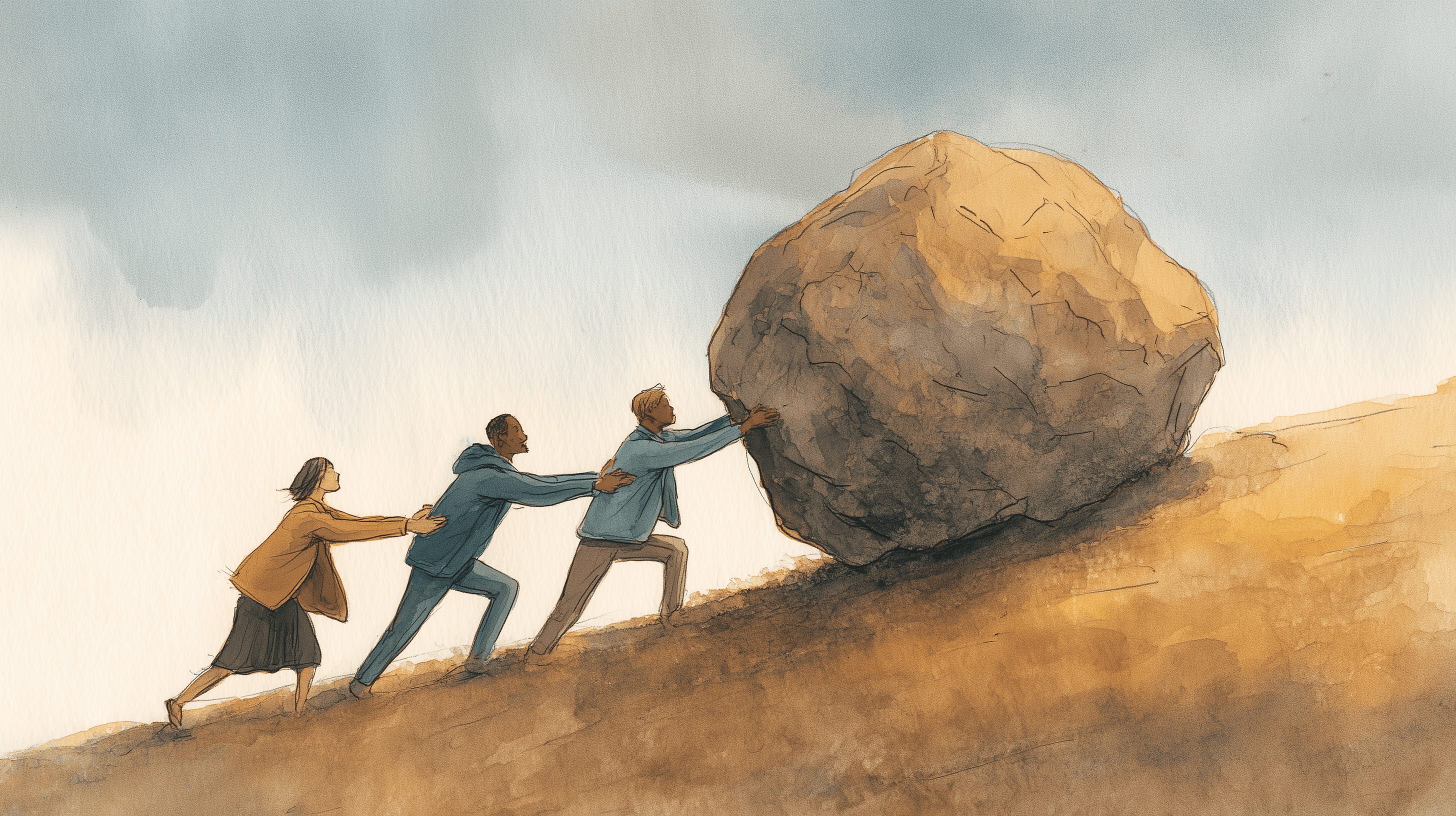
Being set up for success comes from the structure of your organization, the leadership above, the trust between your teammates, and the common goals you work toward every day. The data shows that a triad approach has a much better success rate than building silos. So why does it still happen so often?
The next wave of product leaders won't be the ones who automate their jobs with AI or survive layoffs by keeping their heads down. It will be the ones who bring people together, hold colleagues accountable, and use research data as a weapon against those preserving the status quo.
You want to prove to recruiters and executives that you're that leader? Show them you've built a triad that delivers 35% more revenue and cuts time-to-market in half. That's how you get invited to the table.
References:
Growthfolks – “Align Teams for Faster Marketing Wins: The Ultimate Strategy Guide” (Oct 2025): Provides evidence that aligned organizations are nearly twice as likely to hit financial targets and 2.5× more likely to outperform competitors.
Brixon Group – “The Revenue Gap 2025: How the Divide Between Marketing and Sales Measurably Costs Revenue” (May 2025): Highlights that misaligned teams lose 10–15 % of potential revenue and product launches take 45 % longer.
DesignRush – “40+ Product Design Statistics: UX Metrics, ROI Benchmarks & Data for 2026” (updated Dec 8 2025): Notes that design‑led companies see 32 % faster revenue growth and 56 % higher returns, that bad design drives away 88 % of users, and that well‑designed UIs can boost conversion rates by up to 400 %.
McKinsey & Company – “How high performers optimize IT productivity for revenue growth” (Nov 2024): Shows that high‑performing cross‑functional teams deliver up to 35 % higher revenue growth and 10 % higher profit margins, and that high performers complete medium‑size product changes in 2–4 months versus up to a year for laggards.
Mastering Product – “The Product Trio 2.0: How Cross‑Functional Collaboration Is Evolving” (Apr 2025): Reports that outcome‑focused product trios see 30–45 % faster time‑to‑market and are 25–40 % more likely to hit product success metrics.
Askable – “UX Research Trends in 2025: What Product and Design Leaders Need to Know” (Sep 2025): Documents that teams integrating research report five‑times stronger brand perception and 3.6× more active users, that AI research tools are used by 58 % of teams, and that 55 % of organizations need more research despite budget pressures. It also notes the democratization of research: 70 % of designers, 42 % of PMs and 18 % of marketers conduct their own studies.
More to Discover


Leadership
Only As Good As Your Team
In my last article, I wrote about how designers burn out when they aren't heard or invited to decision-making. Something stuck with me after I published it. Any product design team is only as good as the people around them.
Companies call this group different things. The Core team. Trio. Three-in-a-box. I'm going to call it the triad: product manager, design lead, and engineering lead working together on a product area.
If each side of this pyramid doesn't pull its weight equally, the entire team suffers. That suffering spreads. It affects trust in leadership. It affects promotions, pay, bonuses, and respect within each department. It also results in the blame being placed on one of the three roles when the real problem lies in the structure itself.
This goes beyond being aligned in meetings or enjoying working together. The triad has to tackle problems together, own outcomes together, and back up their work with data and results. Vague results don't count. Revenue increases, shortened time-to-market, and improved brand perception are what count.
Outcome Over Output
The numbers are hard to argue with. Aligned organizations are nearly twice as likely to hit financial targets. Design-led companies see 32% faster revenue growth. Misaligned teams lose 10-15% of potential revenue and take 45% longer to launch products.
When leadership works together and empowers cross-functional teams to make decisions, revenue growth is 35% higher, and profit margins are 10% higher. High performers complete medium-sized product changes in 2-4 months. Lagging teams can take up to a year for the same results.
Organizations that adopt outcome-focused triads achieve 30-45% faster time-to-market and are 25-40% more likely to meet product success metrics than siloed teams.
Getting your product into users' hands faster means you start seeing results sooner. It gives teams time to make adjustments that increase satisfaction. If the triad works from a feature release roadmap instead of an outcome-based one, they're already set up to fail.
AI Changes the Dynamic
AI blurs roles now more than ever. PMs can build prototypes. Designers can ship code. This has led some leadership teams to believe a "product generalist" could replace all three roles.
Merging roles may be cheaper and faster, but it usually degrades product quality. The triad doesn't exist because no one person can do the other's job. It exists because spreading accountability creates strength through tension.
58% of teams now use AI research tools. Yet generative models hallucinate, miscategorize, and produce plausible nonsense. If you don't build evidence gates that let a human review machine-generated insights, you'll ship a product that kills trust much faster than shipping late would.
When you try to make a one-person band, you don't get the same attention for each instrument.
Research Becomes Everyone's Job
70% of UX designers, 42% of product managers, and 18% of marketers now actively gather their own user insights. Research has become a cross-functional responsibility, whether teams planned for it or not.
This happened because UX research teams can only support about half of the requests they receive. Designers started doing their own research out of necessity.
The triad has to adapt, and non-specialists need training to avoid contaminating data. UX researchers are most valuable when they review how others conduct research, review questions and analyses, and lead larger initiatives that inform new product directions. Let the triad focus on existing customers and product needs. Let research specialists handle the bigger picture.
55% of companies report needing more and better user research even as budgets tighten. They aren't looking to hire more people, so they need their existing teams to figure it out.
The Leadership Problem
Different departments lead tech companies of all shapes and sizes, all jockeying for position. This is often a C-level issue that cascades down, causing confusion and frustration. Teams don't know who to listen to and usually default to their individual department head.
When the message at the top differs per team, blaming the triad for not hitting results is hypocritical at best and destructive at worst.
Proving ROI
It's easier for teams to show what isn't working than to have people trust them about what did work. This is the constant battle that happens in many orgs.
Design-centered companies can see up to 32% faster revenue gains. Poor design has driven 88% of users away from products, while properly designed products (UI and experiences) can boost conversion rates by as much as 400%.
These aren't small numbers. They can change a business entirely.
An aligned triad is more likely to hit financial targets and outperform the competition. It starts with that small team working together, having each other's backs, and providing not just results but the actions that stem from them.
Rules for a Successful Triad
Every organization works differently. Different leadership, different regulations, different complexity. But the teams I've led and been part of have all followed these rules:
1. Define joint OKRs tied to business outcomes, not task completion — Reduce customer churn by 3%. Increase conversion rate by 2%. Shared metrics mean shared accountability.
2. Give each member veto rights — Any member can challenge decisions that compromise desirability, viability, or feasibility. Healthy tension prevents groupthink.
3. Make research everyone's job — Build basic training and templates so non-researchers can run simple studies. Free up research specialists for the complex work.
4. Require evidence before major decisions — The triad jointly reviews insights and decides whether to proceed. This prevents AI-generated ideas from bypassing human judgment.
5. Run discovery and delivery at the same time — Dual-track agile. All three roles participate in user research sessions and iterate based on live data.
6. Develop T-shaped skills — PMs learn technical constraints. Engineers join user interviews. Designers learn analytics. Fewer handoffs. More empathy.
7. Treat data as the fourth team member — Make analytics accessible to everyone. When data is treated as a product, decision-making improves.
8. Get leadership to protect discovery time — Executives must invest in research ops and guard against scope creep. Without top-down support, triads revert to firefighting.
9. Tie incentives to team outcomes — Bonuses and promotions based on team results, not individual output.
10. Make dissent safe — Open channels where concerns are welcomed. Distributing responsibility leads to better decisions and less burnout.
The Point
Being set up for success comes from the structure of your organization, the leadership above, the trust between your teammates, and the common goals you work toward every day. The data shows that a triad approach has a much better success rate than building silos. So why does it still happen so often?
The next wave of product leaders won't be the ones who automate their jobs with AI or survive layoffs by keeping their heads down. It will be the ones who bring people together, hold colleagues accountable, and use research data as a weapon against those preserving the status quo.
You want to prove to recruiters and executives that you're that leader? Show them you've built a triad that delivers 35% more revenue and cuts time-to-market in half. That's how you get invited to the table.
References:
Growthfolks – “Align Teams for Faster Marketing Wins: The Ultimate Strategy Guide” (Oct 2025): Provides evidence that aligned organizations are nearly twice as likely to hit financial targets and 2.5× more likely to outperform competitors.
Brixon Group – “The Revenue Gap 2025: How the Divide Between Marketing and Sales Measurably Costs Revenue” (May 2025): Highlights that misaligned teams lose 10–15 % of potential revenue and product launches take 45 % longer.
DesignRush – “40+ Product Design Statistics: UX Metrics, ROI Benchmarks & Data for 2026” (updated Dec 8 2025): Notes that design‑led companies see 32 % faster revenue growth and 56 % higher returns, that bad design drives away 88 % of users, and that well‑designed UIs can boost conversion rates by up to 400 %.
McKinsey & Company – “How high performers optimize IT productivity for revenue growth” (Nov 2024): Shows that high‑performing cross‑functional teams deliver up to 35 % higher revenue growth and 10 % higher profit margins, and that high performers complete medium‑size product changes in 2–4 months versus up to a year for laggards.
Mastering Product – “The Product Trio 2.0: How Cross‑Functional Collaboration Is Evolving” (Apr 2025): Reports that outcome‑focused product trios see 30–45 % faster time‑to‑market and are 25–40 % more likely to hit product success metrics.
Askable – “UX Research Trends in 2025: What Product and Design Leaders Need to Know” (Sep 2025): Documents that teams integrating research report five‑times stronger brand perception and 3.6× more active users, that AI research tools are used by 58 % of teams, and that 55 % of organizations need more research despite budget pressures. It also notes the democratization of research: 70 % of designers, 42 % of PMs and 18 % of marketers conduct their own studies.
More to Discover
Leadership
Only As Good As Your Team
In my last article, I wrote about how designers burn out when they aren't heard or invited to decision-making. Something stuck with me after I published it. Any product design team is only as good as the people around them.
Companies call this group different things. The Core team. Trio. Three-in-a-box. I'm going to call it the triad: product manager, design lead, and engineering lead working together on a product area.
If each side of this pyramid doesn't pull its weight equally, the entire team suffers. That suffering spreads. It affects trust in leadership. It affects promotions, pay, bonuses, and respect within each department. It also results in the blame being placed on one of the three roles when the real problem lies in the structure itself.
This goes beyond being aligned in meetings or enjoying working together. The triad has to tackle problems together, own outcomes together, and back up their work with data and results. Vague results don't count. Revenue increases, shortened time-to-market, and improved brand perception are what count.
Outcome Over Output
The numbers are hard to argue with. Aligned organizations are nearly twice as likely to hit financial targets. Design-led companies see 32% faster revenue growth. Misaligned teams lose 10-15% of potential revenue and take 45% longer to launch products.
When leadership works together and empowers cross-functional teams to make decisions, revenue growth is 35% higher, and profit margins are 10% higher. High performers complete medium-sized product changes in 2-4 months. Lagging teams can take up to a year for the same results.
Organizations that adopt outcome-focused triads achieve 30-45% faster time-to-market and are 25-40% more likely to meet product success metrics than siloed teams.
Getting your product into users' hands faster means you start seeing results sooner. It gives teams time to make adjustments that increase satisfaction. If the triad works from a feature release roadmap instead of an outcome-based one, they're already set up to fail.
AI Changes the Dynamic
AI blurs roles now more than ever. PMs can build prototypes. Designers can ship code. This has led some leadership teams to believe a "product generalist" could replace all three roles.
Merging roles may be cheaper and faster, but it usually degrades product quality. The triad doesn't exist because no one person can do the other's job. It exists because spreading accountability creates strength through tension.
58% of teams now use AI research tools. Yet generative models hallucinate, miscategorize, and produce plausible nonsense. If you don't build evidence gates that let a human review machine-generated insights, you'll ship a product that kills trust much faster than shipping late would.
When you try to make a one-person band, you don't get the same attention for each instrument.
Research Becomes Everyone's Job
70% of UX designers, 42% of product managers, and 18% of marketers now actively gather their own user insights. Research has become a cross-functional responsibility, whether teams planned for it or not.
This happened because UX research teams can only support about half of the requests they receive. Designers started doing their own research out of necessity.
The triad has to adapt, and non-specialists need training to avoid contaminating data. UX researchers are most valuable when they review how others conduct research, review questions and analyses, and lead larger initiatives that inform new product directions. Let the triad focus on existing customers and product needs. Let research specialists handle the bigger picture.
55% of companies report needing more and better user research even as budgets tighten. They aren't looking to hire more people, so they need their existing teams to figure it out.
The Leadership Problem
Different departments lead tech companies of all shapes and sizes, all jockeying for position. This is often a C-level issue that cascades down, causing confusion and frustration. Teams don't know who to listen to and usually default to their individual department head.
When the message at the top differs per team, blaming the triad for not hitting results is hypocritical at best and destructive at worst.
Proving ROI
It's easier for teams to show what isn't working than to have people trust them about what did work. This is the constant battle that happens in many orgs.
Design-centered companies can see up to 32% faster revenue gains. Poor design has driven 88% of users away from products, while properly designed products (UI and experiences) can boost conversion rates by as much as 400%.
These aren't small numbers. They can change a business entirely.
An aligned triad is more likely to hit financial targets and outperform the competition. It starts with that small team working together, having each other's backs, and providing not just results but the actions that stem from them.
Rules for a Successful Triad
Every organization works differently. Different leadership, different regulations, different complexity. But the teams I've led and been part of have all followed these rules:
1. Define joint OKRs tied to business outcomes, not task completion — Reduce customer churn by 3%. Increase conversion rate by 2%. Shared metrics mean shared accountability.
2. Give each member veto rights — Any member can challenge decisions that compromise desirability, viability, or feasibility. Healthy tension prevents groupthink.
3. Make research everyone's job — Build basic training and templates so non-researchers can run simple studies. Free up research specialists for the complex work.
4. Require evidence before major decisions — The triad jointly reviews insights and decides whether to proceed. This prevents AI-generated ideas from bypassing human judgment.
5. Run discovery and delivery at the same time — Dual-track agile. All three roles participate in user research sessions and iterate based on live data.
6. Develop T-shaped skills — PMs learn technical constraints. Engineers join user interviews. Designers learn analytics. Fewer handoffs. More empathy.
7. Treat data as the fourth team member — Make analytics accessible to everyone. When data is treated as a product, decision-making improves.
8. Get leadership to protect discovery time — Executives must invest in research ops and guard against scope creep. Without top-down support, triads revert to firefighting.
9. Tie incentives to team outcomes — Bonuses and promotions based on team results, not individual output.
10. Make dissent safe — Open channels where concerns are welcomed. Distributing responsibility leads to better decisions and less burnout.
The Point
Being set up for success comes from the structure of your organization, the leadership above, the trust between your teammates, and the common goals you work toward every day. The data shows that a triad approach has a much better success rate than building silos. So why does it still happen so often?
The next wave of product leaders won't be the ones who automate their jobs with AI or survive layoffs by keeping their heads down. It will be the ones who bring people together, hold colleagues accountable, and use research data as a weapon against those preserving the status quo.
You want to prove to recruiters and executives that you're that leader? Show them you've built a triad that delivers 35% more revenue and cuts time-to-market in half. That's how you get invited to the table.
References:
Growthfolks – “Align Teams for Faster Marketing Wins: The Ultimate Strategy Guide” (Oct 2025): Provides evidence that aligned organizations are nearly twice as likely to hit financial targets and 2.5× more likely to outperform competitors.
Brixon Group – “The Revenue Gap 2025: How the Divide Between Marketing and Sales Measurably Costs Revenue” (May 2025): Highlights that misaligned teams lose 10–15 % of potential revenue and product launches take 45 % longer.
DesignRush – “40+ Product Design Statistics: UX Metrics, ROI Benchmarks & Data for 2026” (updated Dec 8 2025): Notes that design‑led companies see 32 % faster revenue growth and 56 % higher returns, that bad design drives away 88 % of users, and that well‑designed UIs can boost conversion rates by up to 400 %.
McKinsey & Company – “How high performers optimize IT productivity for revenue growth” (Nov 2024): Shows that high‑performing cross‑functional teams deliver up to 35 % higher revenue growth and 10 % higher profit margins, and that high performers complete medium‑size product changes in 2–4 months versus up to a year for laggards.
Mastering Product – “The Product Trio 2.0: How Cross‑Functional Collaboration Is Evolving” (Apr 2025): Reports that outcome‑focused product trios see 30–45 % faster time‑to‑market and are 25–40 % more likely to hit product success metrics.
Askable – “UX Research Trends in 2025: What Product and Design Leaders Need to Know” (Sep 2025): Documents that teams integrating research report five‑times stronger brand perception and 3.6× more active users, that AI research tools are used by 58 % of teams, and that 55 % of organizations need more research despite budget pressures. It also notes the democratization of research: 70 % of designers, 42 % of PMs and 18 % of marketers conduct their own studies.